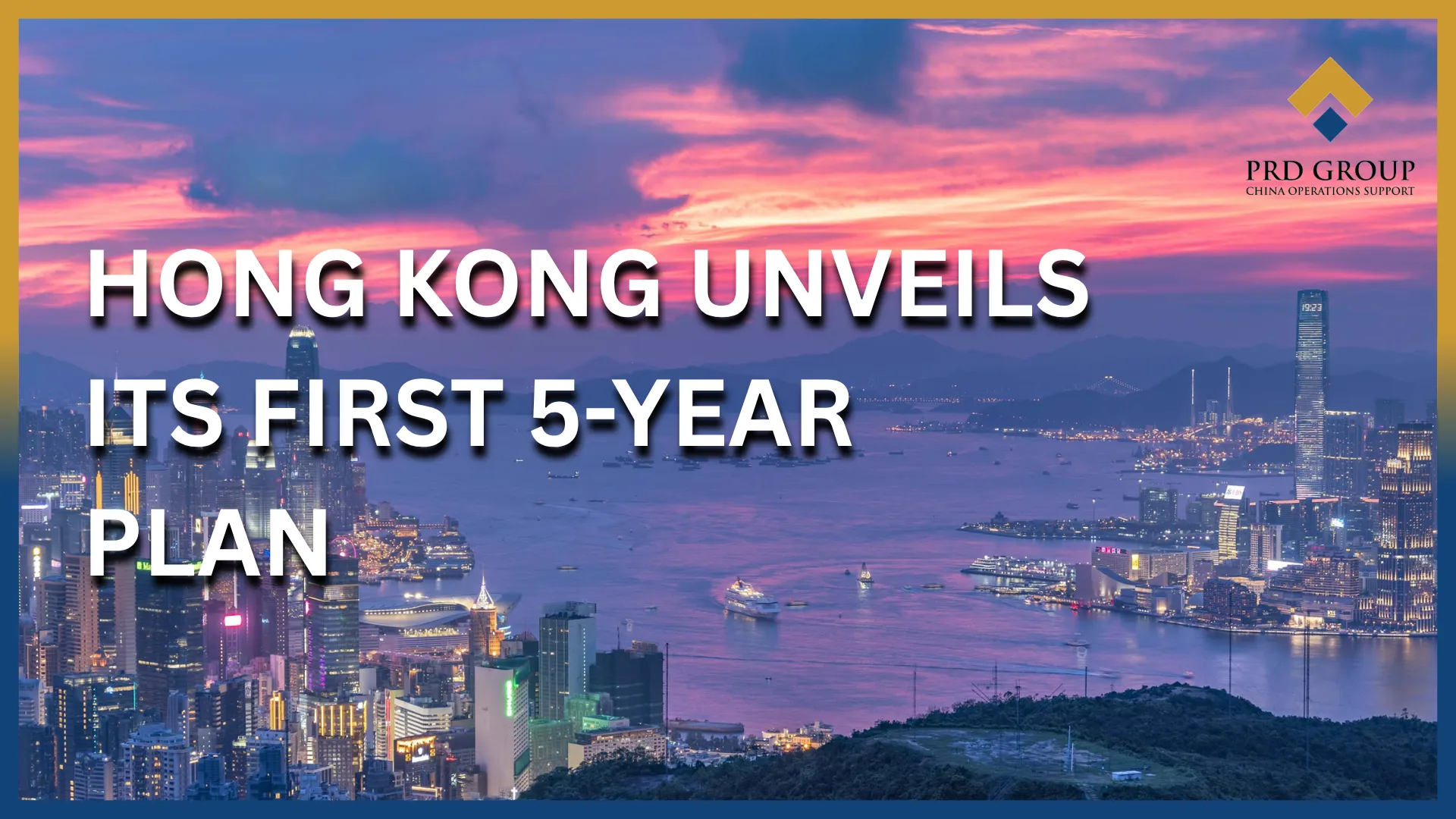
Hong Kong has published its first Five-Year Plan for Economic and Social Development, setting out the government’s priorities for the period from 2026 to 2030. Announced by Chief Executive John Lee on 16 September, the plan covers economic development, technology, infrastructure, regional integration and social policy.
The plan represents a more structured approach to Hong Kong’s long-term development. The government has described it as a strategic framework for setting priorities and coordinating resources, while maintaining Hong Kong’s existing market-based economic system. It contains 105 indicators covering economic, social and administrative objectives.
Finance, trade and technology remain at the centre
Hong Kong intends to further strengthen its traditional roles as an international financial, maritime, trade and aviation centre, while placing greater emphasis on innovation, technology and high-value industries.
In financial services, priorities include strengthening Hong Kong’s position as the world’s largest offshore renminbi business hub, expanding asset and wealth management, developing commodity trading and supporting areas such as green finance and digital finance. The government also plans to launch a central clearing and settlement system for gold in 2027.
Technology forms another major part of the strategy. Hong Kong plans to focus development on areas including artificial intelligence and robotics, life and health technology, microelectronics, new energy, advanced manufacturing and new materials. The government aims to gradually raise domestic expenditure on innovation activities from 1.63% of GDP in 2024 towards 3% after 2030.
The plan also seeks closer cooperation between universities, research institutions and businesses to support the commercialisation of research and the development of new industries. Measures announced alongside the plan include additional support for AI adoption and funding for technology-focused companies.
Northern Metropolis as a new economic area
A central element of the plan is the continued development of the Northern Metropolis, a large development area close to Shenzhen and the Mainland China border.
The government sees the area as a future centre for technology, education, industry and housing. Plans include three university towns in San Tin, Hung Shui Kiu and Ta Kwu Ling, alongside technology parks, research facilities and new residential areas. San Tin in particular is planned as a centre for sectors including AI, robotics, microelectronics, medicine and life sciences.
Once fully developed, the Northern Metropolis is expected to accommodate around 2.5 million people and provide approximately 650,000 jobs. The government also intends to deliver 196,000 public housing units across Hong Kong during the coming five years.
Deeper Greater Bay Area integration
The plan also places further integration with the Guangdong-Hong Kong-Macao Greater Bay Area (GBA) among Hong Kong’s strategic priorities.
Hong Kong plans to deepen cooperation with Mainland cities in technology, industrial development, infrastructure, talent and the commercialisation of research. This includes closer links with neighbouring Shenzhen and further development of common standards and cross-border business infrastructure.
At the same time, Hong Kong intends to maintain its role as an international gateway between Mainland China and global markets. The plan specifically highlights international trade, cross-border investment, professional services and Hong Kong’s role as a platform for companies operating between China and overseas markets.
What the plan means for businesses
For companies operating in Hong Kong or considering the city as a base for Asian operations, the Five-Year Plan provides a clearer indication of where government policy and investment are expected to concentrate over the coming years.
Financial services, technology, advanced manufacturing, research and development, logistics and supply chain services are among the sectors receiving particular attention. Measures announced through the accompanying Policy Address also include proposed incentives for selected industries and further development of the Northern Metropolis as a location for new business activity.
The overall direction combines Hong Kong’s established functions in finance and international trade with increased emphasis on technology, industrial development and Greater Bay Area integration. How individual measures are implemented will become clearer through future Policy Addresses, budgets and sector-specific policies during the 2026–2030 period.
For European companies, Hong Kong’s Five-Year Plan creates new opportunities to establish and grow a presence in the region, particularly as investment increases in technology, trade, finance and Greater Bay Area integration. PRD Group can help companies get started in Hong Kong with practical local support, including company incorporation, company secretary services and ongoing business administration. Contact us to discuss how we can support your entry into Hong Kong and the wider China market.